
🎌 Small words with big ideas
Some words hold a whole philosophy of life. Japanese has several of them, and they have taken on a life far outside Japan. Here are six concepts I keep coming back to myself. For each one you get a short explanation and a concrete suggestion for how to use it.
🏺 1. Kintsugi (金継ぎ): the beauty in the cracks
Kintsugi is an old technique for repairing cracked pottery. The pieces are joined with lacquer, and the seams are covered with gold. Instead of hiding the breaks, you highlight them, so the bowl becomes more beautiful than it was before. The point is that our imperfections, and the things we have been through, are often what make us who we are.
How to use it: The next time you are annoyed by a mistake, ask yourself what it has taught you. A scar is also proof that something has healed.
📈 2. Kaizen (改善): small steps every day
Kaizen means improvement and is used about continuous, small improvements. The concept became known through Japanese industry, but the idea fits a human life just as well. Big changes rarely happen overnight. They come from small, steady improvements that build on each other over time.
How to use it: Pick one thing you would like to get better at, and do it a little better today than yesterday. Five minutes a day is enough to get started, and it is easier to keep up than a big plan.
🌸 3. Oubaitori (桜梅桃李): bloom at your own pace
The four characters stand for cherry, plum, peach and apricot. The trees each bloom in their own time in spring, and none of them tries to bloom like the others. The message is simple: do not compare yourself with others, because everyone has their own pace and their own path.
How to use it: When you catch yourself measuring yourself against others, compare yourself instead with the person you were a year ago. That is the only comparison that says something about your own growth.
🍚 4. Hara hachi bu (腹八分目): eat until you are 80 percent full
Hara hachi bu means that you stop eating when you are about 80 percent full. The expression is especially associated with Okinawa. It reflects the fact that feeling full takes time, and it is often said that the brain needs around 20 minutes to register that the stomach is full. The concept is a reminder to slow down and leave a little room.
How to use it: Eat more slowly, put your cutlery down between bites, and stop when you are no longer hungry rather than when you are completely full.
🌅 5. Ikigai (生き甲斐): a reason to get up in the morning
Ikigai can be translated as something like "what makes life worth living". Outside Japan the concept is often shown as four overlapping circles: what you love, what you are good at, what the world needs, and what you can be paid for. Ikigai is the point where they meet in the middle.
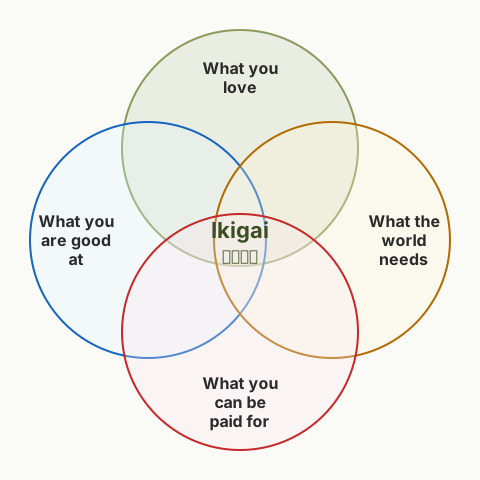
The four circle model is a Western interpretation. In Japan, ikigai is used more broadly and can also be the small things that bring joy to everyday life, like a morning coffee, a garden or time with the grandchildren. So it does not have to be a calling or a job.
How to use it: Write down a few things under each of the four headings and see where they meet. Also ask yourself which small things in your everyday life make you look forward to the day.
🍃 6. Shikata ga nai (仕方がない): let go of what you cannot change
Shikata ga nai means roughly "it cannot be helped". It is about accepting what you have no influence over instead of spending your strength fighting it. That is not the same as giving up. The energy moves to what you can actually affect. The expression can also be used about resignation, so it is worth using it with care.
How to use it: When something bothers you, split it in two: what you can do something about, and what you cannot. Let go of the second, and spend your energy on the first.
🧭 One concept at a time
You do not need to take in all six concepts at once. Pick one that speaks to you right now, and try it for a week or two. The concepts are inspiration, not a complete description of Japanese culture, which is far richer and more nuanced than six words can hold. But as small guideposts in everyday life, they can make a difference.